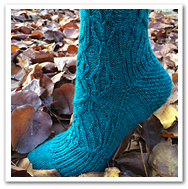
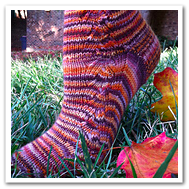
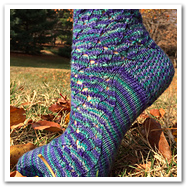
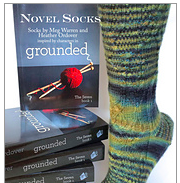
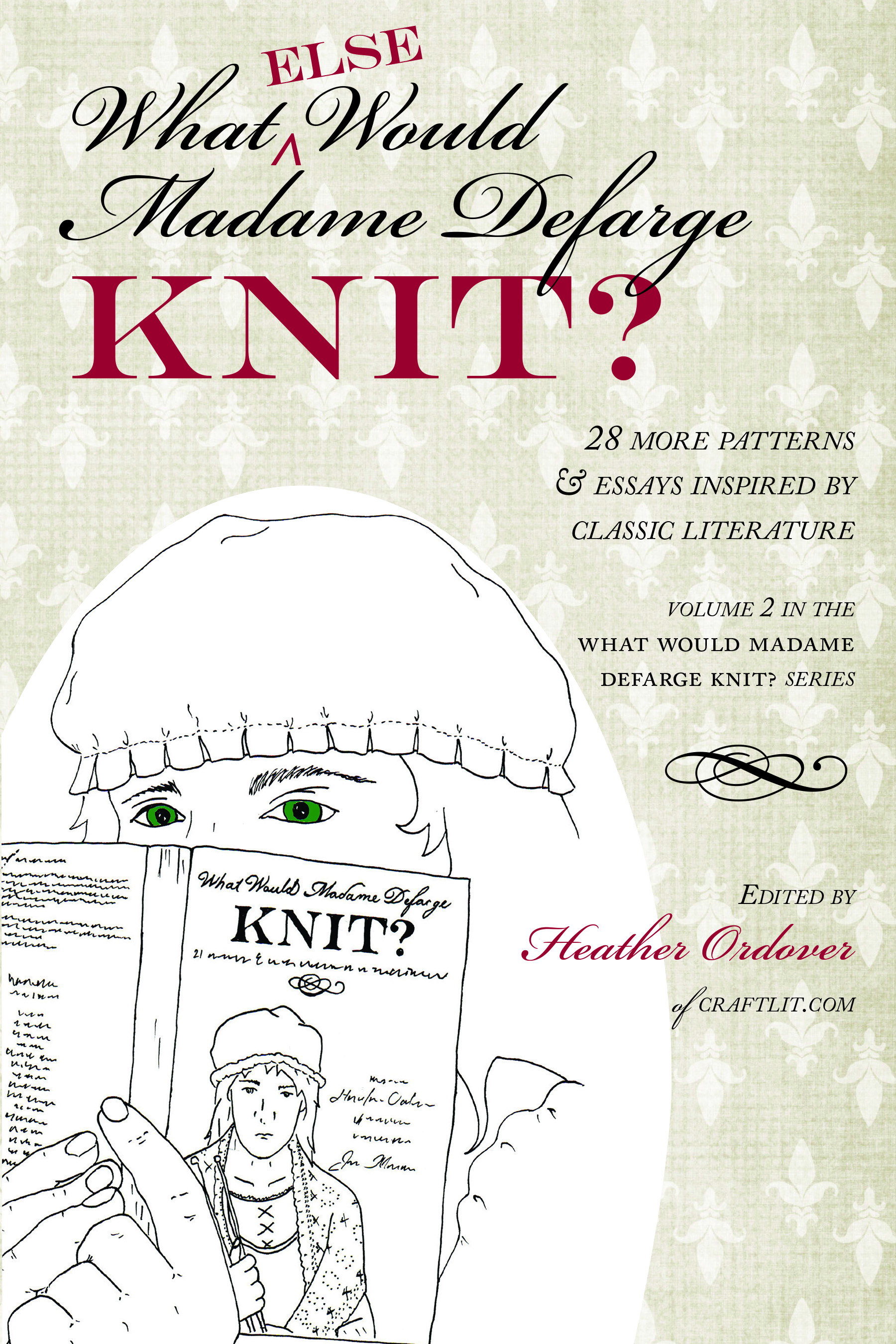
I am the author of Grounded and the editrix of the What Would Madame Defarge Knit? series of knit (and crochet) pattern books where the patterns are based on characters from classic literature.
From my CraftLit folks I often get questions about “how to”… fill in the blank. I decided I should get a move on and get some tutorials compiled here for y’all. So.
Crochet.
Don’t know that I agree with the arcylic recommendation (I’d just say any tightly plied yarn–no splitting) but I really like that they work you towards a product rather than just chaining forever.
Here’s Part I of the basics of crochet.
Yesterday, in anticipation of the upcoming release of What Would Madame Defarge Knit? our artiste extraordinairé created free holiday cards for you and yours to use this holiday season. You can view and download the goodies over at the Madame Defarge site. More goodies will be a-comin’ so keep checking back.
Then, in my other guise as edumacator, I thought I’d share this with you…just in case you didn’t know from Bayeux yet.
There will be recipes for the traditional foods Dickens wrote of in A Christmas Carol, or recipes that would have been found in Victorian England around the holidays. There will be a professional reading of the story available as a podcast. There will be giveaways, themed knitting patterns and quite possibly hats! There may be smoking bishop and suet cooked in organs. And there will certainly be much making of merry.
The blog entries will be rolling out starting this week and culminating Thanksgiving weekend to kick off your holidays in Victorian style.
So please do bookmark all our blogs and add them to your rss feeders. We’ll be using the below to link all the blog entries for the entire shebang so that you don’t miss a single one. We hope you enjoy this as much as we know we will! And we hope that you have a DICKENS OF A CHRISTMAS!
In case this all has made you hungry for your own bit of Dickens…
Listen to or right-click-to-download A Christmas Carol by Charles Dickens—Stave 3 mp3 audio only audio
Staves 4-5 will be uploaded Friday, 19 November 2010!
You can also visit CraftLit’s main site, go straight to the CraftLit Library to download mp3 copies of old episodes, go to the CD store to purchase mp3-CD compilations of the books, go to iTunes to subscribe for free, to the iTunes store to purchase the CraftLit app (which takes up less space on your iPhone or iTouch than downloading the episodes does), or listen via the players on the site or here at MamaOKnits.
Don’t forget the rest of the Dickens of a Christmas blog hopping fun! Please follow the linky-links above to
There will be recipes for the traditional foods Dickens wrote of in A Christmas Carol, or recipes that would have been found in Victorian England around the holidays. There will be a professional reading of the story available as a podcast. There will be giveaways, themed knitting patterns and quite possibly hats! There may be smoking bishop and suet cooked in organs. And there will certainly be much making of merry.
The blog entries will be rolling out starting this week and culminating Thanksgiving weekend to kick off your holidays in Victorian style.
So please do bookmark all our blogs and add them to your rss feeders. We’ll be using the below to link all the blog entries for the entire shebang so that you don’t miss a single one. We hope you enjoy this as much as we know we will! And we hope that you have a DICKENS OF A CHRISTMAS!
In case this has all made you hungry for your own bit of Dickens…
Not only is this a great idea, but it’s also got a link to a truly useful article on how things like weather and elevation affect food prep. I’ve found myself frustrated by the difference in baking between New York and Arizona, so this was something of a culinary life-saver. (The articles are also written by an old friend of mine.)
Enjoy this interlude in the Dickens of a Christmas line-up.
Ever needed to add a few stitches—like to make up for thumb gusset stitches you just eliminated from the palm of your mitten. Well, here’s an easy and quick way to accomplish that.
The standard half-hitch manoeuver always left me with saggy cast-on stitches. A friend showed me this ages ago and I’ve never looked back.
Sometimes you just want a scarf that won’t roll—EVER.
Or sometimes you need the back of an item to look just like the front. The easiest way to do that is to double knit—and mirror your pattern in reverse.
On this sample, you’ll see the red side facing you with white “flea” stitches. The reverse side of the fabric is EXACTLY the same, but white with red “flea” stitches.
How do you do that?
Double knitting—knitting both sides at once. That means the red stitches will all be knit stitches, followed by it’s partnered white stitch which you will purl. It helps to remember that all stitches are knit side facing out and purl side facing in to the tube you’re creating (genius, no?).
And it makes a LOT more sense actually watching it.
For practice try doing a simple double-knit tube (bookmark?). Start by taking any size yarn and needles—variegated that changes color rapidly is quite helpful.
For the tube:
Cast on 20 stitches.
Turn.
Knit 1, purl 1 across.
Turn.
Now, *knit the knit stitches you see and slip (slip and ignore) the purl stitches you see, all the way across.
Turn.
Now, knit the knit stitches and slip the purl stitches across.*
Now you have knit one complete row each side!
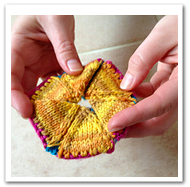
Keep going * to * for an inch or so, then pinch each side of the fabric and pull apart.
Neat, no?!
You can pull the sides away from each other because you formed a tube.
(If you CAN’T pull the sides apart that most likely means that somewhere you accidentally purled a stitch that should have been slipped.)
Now, pat yourself on the back and show this to everyone you meet today.
Someone will be impressed.
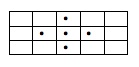
If you want to get really crazy, try the two colors in the video. Use a long tail cast on with one color going over your thumb and the other color over your finger. You’ll have a lovely little braided cast-on. Then start double knitting. At first you would want to keep one side one color and the other side the other color, as it’s easier to get the rhythm of the knitting/purling that way. But if you wanted to create a simple star pattern, you could easily use a pattern like this
The hardest thing to wrap your mind around is that you see five stitches on the chart, but you’ll really be knitting/purling ten.
Let’s break that down. Imagine you’re knitting with red and white. Start by deciding (this is arbitrary) that the blank squares in our little star pattern will be for the white facing you and the dots will be for the red facing you—those will be your knit stitches.
To mirror that pattern on the other side you need to purl it in the reverse colors—dominant red with a white star. That is what you will be purling.
So your first row will go like this:
(white-dominant side facing) knit white, purl red, knit white, purl red, knit red, purl white, knit white, purl red, knit white, purl red (10 pattern stitches total, bold indicates the lower point of the star)
turn
(red-dominant side facing) knit red, purl white, knit white, purl red, knit white, purl red, knit white, purl red, knit red, purl white (bold indicates the middle row of the star)
etc
I promise you this makes much more sense if you try it. I still have my first little tube bookmark and I’m still pretty impressed with myself every time I do this. Once you master this it’s easy to do other nifty things like knitting a sock inside a sock.
As I’ve been plagued lately by lower back pain, I, of course, assumed that everyone else had the same issue. Thus I thought it might be good to bring in a guest blogger with some actual information.
Back Pain 101
In a survey by the Centers for Disease Control and Prevention, 25% of Americans over the age of 20 reported having suffered pain that lasted 24 hours or more at least once over the past year. Among people over the age of 65, almost 60% had pain that lasted a year or more. One of the most common forms of pain is back pain. In fact, the average American can expect to suffer from back pain at least once in his or her lifetime. For many people, back pain becomes a long-term problem.
The back is a miracle of engineering. It helps us to stand upright but also gives us the flexibility to bend and twist. It protects the spinal cord and is able to withstand the tremendous forces of walking, running, stepping, and lying down.
The back bone consists of a stack of 24 individual bones called vertebrae that rest one on top of the other. If you’ve ever studied anatomy, you know that these vertebrae are of different shapes at different points along the back. The vertebrae around the neck area (the “cervical spine” area where the vertebrae are typically labeled C1, C2, and so on) are much smaller than the vertebrae of the lumbar or lower back region. The vertebrae around the chest or thoracic cavity have the least flexibility and are anchored or stabilized by the ribs. At the end of the vertebral column is the sacrum and the tailbone, which do not look like the other vertebrae. In fact, the sacrum and the tailbone consist of several bones fused together.
Working together with the vertebral column are muscles, tendons, ligaments, and nerves. Considering the complexity of the system, it is no wonder that the back can be vulnerable to certain types of injury.
Back pain may seem simple, but it is actually exceedingly complex. There are many causes of back pain and, as such, not all back pain will respond to the same treatment. People with back pain must consult with a physician in order to get the right diagnosis, that is, to learn the cause of the problem.
Some back pain may be caused by a muscle sprain or spasm. Characteristics of this type of back pain include a sudden onset and the fact that it usually diminishes and eventually goes away over time, typically in a few days or weeks.
Some other things that can produce back pain include arthritis, osteoporosis, and sciatica. Arthritis is a degenerative disease meaning it causes the joints to wear out. Osteoporosis is a condition where the bones get thin, porous, brittle, and susceptible to injury including fracture. Sciatica is a condition where the sciatic nerve becomes inflamed. The sciatic nerves run from the back on each side over the buttock and down the leg.
Back pain can also be caused by a skeletal abnormality, that is, being born with a vertebral column that has some kind of curve or malformation that produces pain. Scoliosis, for example, is a condition where the spine curves to one side.
The vertebrae have discs in between them that act like shock absorbers to cushion the stress the vertebrae undergo when a person walks, runs, or moves around. These discs are made of a soft material that can be damaged. If the disc ruptures or bulges out of place, it can put pressure on a nerve and cause pain. Not every ruptured or herniated disc causes pain and the pain caused from such a problem varies widely among patients. It may be mild or it may be severe.
There are many other conditions that can cause back pain. When the damage to your back is caused by some trauma or injury, you need medical care so that the damage can heal correctly. However, if your back pain is caused by a chronic degenerative condition or a skeletal defect, you may always have to deal with some degree of pain.
Pain management tactics that have worked with some back pain patients include an ice pack on the affected area or a heating pad, warm showers, topical pain relievers, and massage. Many people find relief for back pain by seeing a chiropractor. When you are well enough, you may benefit from exercises designed to help strengthen the muscles that support the back.
There are situations where you may need to take a pain reliever for back pain. This is a good topic to discuss with your physician. While over-the-counter pain relievers can provide relief, these are real drugs that must be taken with care. Read the instructions and do not take more than you should or take them for a long period of time. If you need long-term pain relief, you must discuss this with your physician to find the best solution for you.
Back pain is not uncommon. But it can be complex, and you need to find out all you can about your particular type of back pain in order to get the most appropriate care.
About the Author:
If you or a loved one suffers from chronic pain, join the community at http://associationofchronicpainpatients.org/ to help raise awareness about chronic pain. This article was written by Jo Ann LeQuang of the ACPP.
I don’t care how you vote (okay, I do, but not for the reasons you think) and I don’t get political on this blog, but I do get “family” on this blog.
So.
Please encourage your friends and family to vote today. Just not with their feelings. Encourage everyone to vote with their heads. Ignore the hype. Ignore the attack ads. Look at the documentation from the League of Women voters–they’re sane. If you know swing voters, encourage them to examine their minds, not their hearts. Remind them to think.
I hear so much vitriol and so much insanity, but it’s all obfuscating the obvious. Whether politicians are good communicators or not doesn’t matter. You can go look at the Congressional Record. We have that power. If you see a vote that makes no sense to you, don’t blow the politician off as an idiot (as I often find myself doing). Go look at why. You’ll be surprised by the things that are hidden in votes that look like no-brainers. There are non-partisan sites that help you parse this stuff. There are good people out there just like you and me (well, better than me, anyway, because they’re doing something). We need to be encouraging them, not the screamers.
Encourage sanity. Encourage thought. Encourage people to look at platforms and voting records, not hype and commercials. Don’t let the Media Monkey sit on your friend’s House Hippo.
And hey?
Let’s be careful out there.
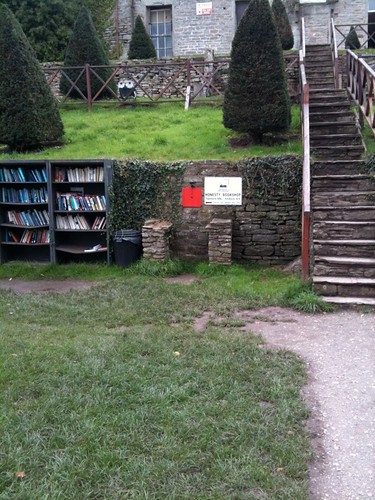
The Honesty Bookstore, Hay-on-Wye, Wales, UK
(no, really. There’s just a box for you to put money in)
MamaO is Heather Ordover, author, designer, mother and knitter... not necessarily in that order. You can get posts from this blog sent directly to your inbox by signing up below, Follow her on Twitter and Like her on Facebook if you're feeling friendly-like. Follow @MamaO







 MamaO is Heather Ordover, author, designer, mother and knitter... not necessarily in that order. You can get posts from this blog sent directly to your inbox by signing up below, Follow her on Twitter and Like her on Facebook if you're feeling friendly-like.










 Visit HOrdover's Craftsy Pattern Store »